Los Angeles
Evan Holloway
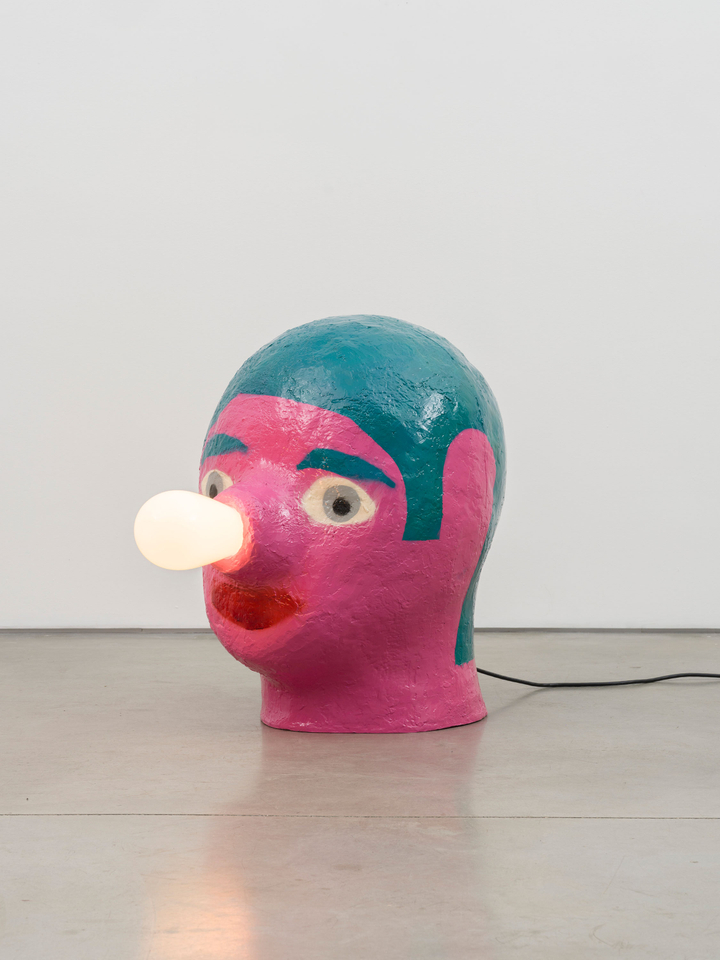
HEADLAMP BL/PK, 2026
powder-coated aluminum, high temperature spray paint, blown glass, LEDs, and wiring components
32 x 21 1/2 x 35 1/4 inches
(81.3 x 54.6 x 89.5 cm)
David Kordansky Gallery is pleased to present ROYGBIV, an exhibition of new sculptures by Evan Holloway. The exhibition, on view at the gallery's Los Angeles location, opens on May 16 and will remain on view through June 20, 2026. An opening reception will be held on Saturday, May 16 from 6PM until 8PM.
ROYGBIV finds Holloway highlighting and recontextualizing what has become perhaps his most recognizable sculptural form and also introducing a new body of work. A group of new, large-scale head sculptures made from powder-coated and spray-painted aluminum, each outfitted with a working lightbulb in place of a nose, are shown adjacent to a new series of balancing tabletop sculptures in which movable steel elements rest atop ceramic bases. The exhibition is at once a celebration of an iconic series of objects and a quizzical, open-minded attempt on the part of their maker to understand their meaning, power, and longevity as features in the contemporary art landscape over the last two decades, not to mention as powerful—if inscrutable—facets of his overall project. In addition to being part of an ongoing conversation with his audience and the artists and art historical movements that have influenced him, the show might also be considered an act of communing with the spirit of the heads themselves in an attempt to better understand what animates them.
While Holloway has combined smaller iterations of the heads in his well-known head stacks, with this new series he brings attention to the singular—and monumental—presence of the head as a standalone object with notable visual mass and a tangible relationship to the floor beneath it. As the show's title suggests, Holloway has made heads in each of the seven colors of the visible spectrum, which points to their very real, light-bulb-driven luminosity as well as to their immediately recognizable, open-ended symbolism. If they can be read, like head sculptures made by many ancient cultures throughout the world, as grave, mysterious, and imposing, they simultaneously come across as whimsical, inviting, and cheerful. The heads' seeming adaptability to many interpretive modes does little to diminish their strangeness, which is only amplified by the shift in scale that characterizes the new works.
Like the colors of the rainbow they inhabit as a group here, the heads can signify many things in many ways. Originally emerging from a 2004 studio experiment based on a papier-mâché cast, they have come to symbolize Holloway's project in ways that have exceeded his own intentions. They paradoxically underscore the experimental ethos that guides his activities by demonstrating that it is impossible to fully predict an artwork's eventual effect or import. What began as an offhanded sculptural gesture has grown into a modular, seemingly endless vocabulary of shape, color, and contextual adaptation. Head-based sculptures have materialized for indoor and outdoor settings and commercial and institutional exhibitions alike, where some viewers might understand them as punctuation marks in the grammar of Holloway's broader, modernist-inflected artistic endeavor, while others might engage with them as one-off, populist gestures intended to elicit laugher and joy.
ROYGBIV encourages both responses by allowing viewers to move through a field of the heads and experience their presences through one-to-one, embodied conversations with them. As a sculptor committed to preserving a palpable relationship between his own body and his materials, Holloway foregrounds physicality and immediacy. Each element of the heads demands reckoning with specific textures. The blown-glass light bulbs, for instance, resemble their smaller, household cousins even as they startle because of their size and placement. The pitted aluminum surfaces, meanwhile, are sites of endless variation that split the difference between high-finish and rough-hewn organic feel in unlikely ways. This creates cognitive dissonance between the works' simultaneous approachability and diffidence—their warmth and their coldness, in other words—so that another kind of relationship to them, at once more personal and more transpersonal, can emerge.
By staking out this point between what might seem eccentric or perplexing and what feels familiar, Holloway shows how the assigning of cultural value is a conflict-ridden exercise perhaps best confronted with a similarly heterogeneous combination of humor, openness, and skepticism. The balancing sculptures on view here are infused with this spirit. These are rough abstract forms in steel contrived to rotate on the point of a single nail-head raised above colorful glazed stoneware. The results of the kind of DIY, hands-on approach that the artist considers an integral part of his activity, they draw upon his interest in 20th-century sculptural and formal vernaculars while establishing connections to other bodies of his work. While some of these connections are more formally overt—his series of tree sculptures comes to mind—some are more tangential or associative. Seen alongside the heads, they might suggest, for example, the delicate and provisional flights of imagination that take place inside the minds of such totemic, diffident objects. In this sense they also evoke the leaps required to trust one's materials to lead the way, including the uneasy poise—and willingness to fall—that come along with working against the aesthetic grain.
That an artist's work gains in cultural relevance as it becomes more idiosyncratic is a proposition with powerful aesthetic and economic reverberations. ROYGBIV invites speculation about these facets of the modernist project, but it also finds Holloway peering into areas where the personal impulse recedes and more mysterious forces light the way. Whether these forces are understood to be collective drives to represent human bodies and experiences using the stuff of the external world, or quasi-mystical desires to find something like an interior, imaginative life in otherwise inert materials, they hint at the transformative potential of art as a social as well as an individually imaginative phenomenon.
Holloway has been featured in numerous group exhibitions around the world, including Fictions of Display, Museum of Contemporary Art, Los Angeles (2025); The Sculpture Park, Madhavendra Palace, Nahargarh Fort, Jaipur, India (2017); Los Angeles - a fiction, Musée d’art contemporain de Lyon, France (2017) and Astrup Fearnley Museet, Oslo (2016); Don’t Look Back: The 1990s at MOCA, The Geffen Contemporary, Los Angeles, CA (2016); Lightness of Being, Public Art Fund, City Hall Park, New York, NY (2013); All of this and nothing, Hammer Museum, Los Angeles, CA (2011); 2008 California Biennial, Orange County Museum of Art, Newport Beach, CA (2008); The Uncertainty of Objects & Ideas, Hirshhorn Museum and Sculpture Garden, Washington, D.C. (2006); and Whitney Biennial 2002, Whitney Museum of American Art, New York, NY (2002). His work is in the permanent collections of museums including the Hirshhorn Museum and Sculpture Garden, Washington, D.C.; Hammer Museum, Los Angeles, CA; Los Angeles County Museum of Art, CA; Museum of Contemporary Art Chicago, IL; Museum of Contemporary Art, Los Angeles, CA; Museum of Contemporary Art, San Diego, CA; Palm Springs Art Museum, CA; and Whitney Museum of American Art, New York, NY. Holloway lives and works in Los Angeles.